DRUMHELLER · ABOUT 16 KM SOUTH-EAST · HOODOOS AND COULEES
The hoodoos at first light
Between Rosedale and East Coulee, a cluster of stone-capped pillars stands on a slope above Highway 10. Come early, before the heat and the crowds, when low sun picks out every layer.
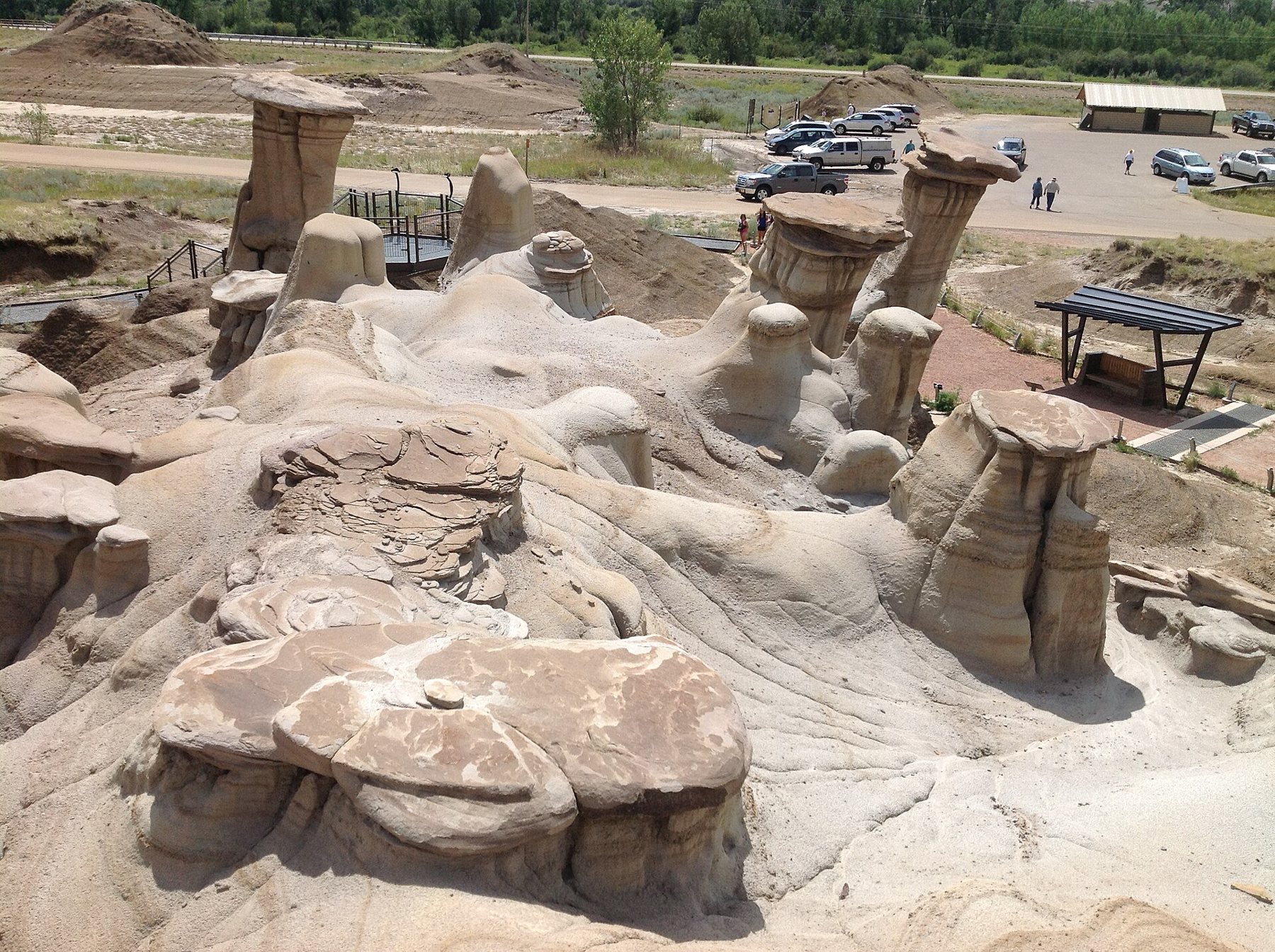
Highway 10 follows the Red Deer River south-east out of Drumheller, through Rosedale and on toward East Coulee. The valley walls close in, the slopes turn to bare grey and buff rock, and then, on the hillside beside the road, a group of strange pillars appears: tall, pale columns, each wearing a flat stone cap like a hat. These are the hoodoos, the best-known landforms of the Drumheller valley, and the reason many visitors drive this road at all.
They are best seen early. In the first hour after sunrise, the light comes low across the valley, the colours are warm, and the site is quiet. By late morning in summer, the parking area fills, the heat builds and the pillars look flatter in the high sun.
Caps of hard stone over soft columns
A hoodoo is a column of soft rock protected by a harder cap. Here, both are part of the Horseshoe Canyon Formation, the layered sandstones, mudstones and coal seams that make up the walls of the valley. The columns are made of soft, poorly cemented sandstone and clay that erodes easily. The caps are a harder layer of sandstone, cemented by minerals so that it resists rain and frost far better than the rock below.
As rain and meltwater wash away the slope around them, the parts of the hillside sheltered by the hard layer erode more slowly. Over a very long time, a pillar forms beneath each piece of cap. The cap acts like an umbrella, shielding the column from rain falling straight down. Wind and side-blown rain still wear at the sides, so the columns narrow toward the top.
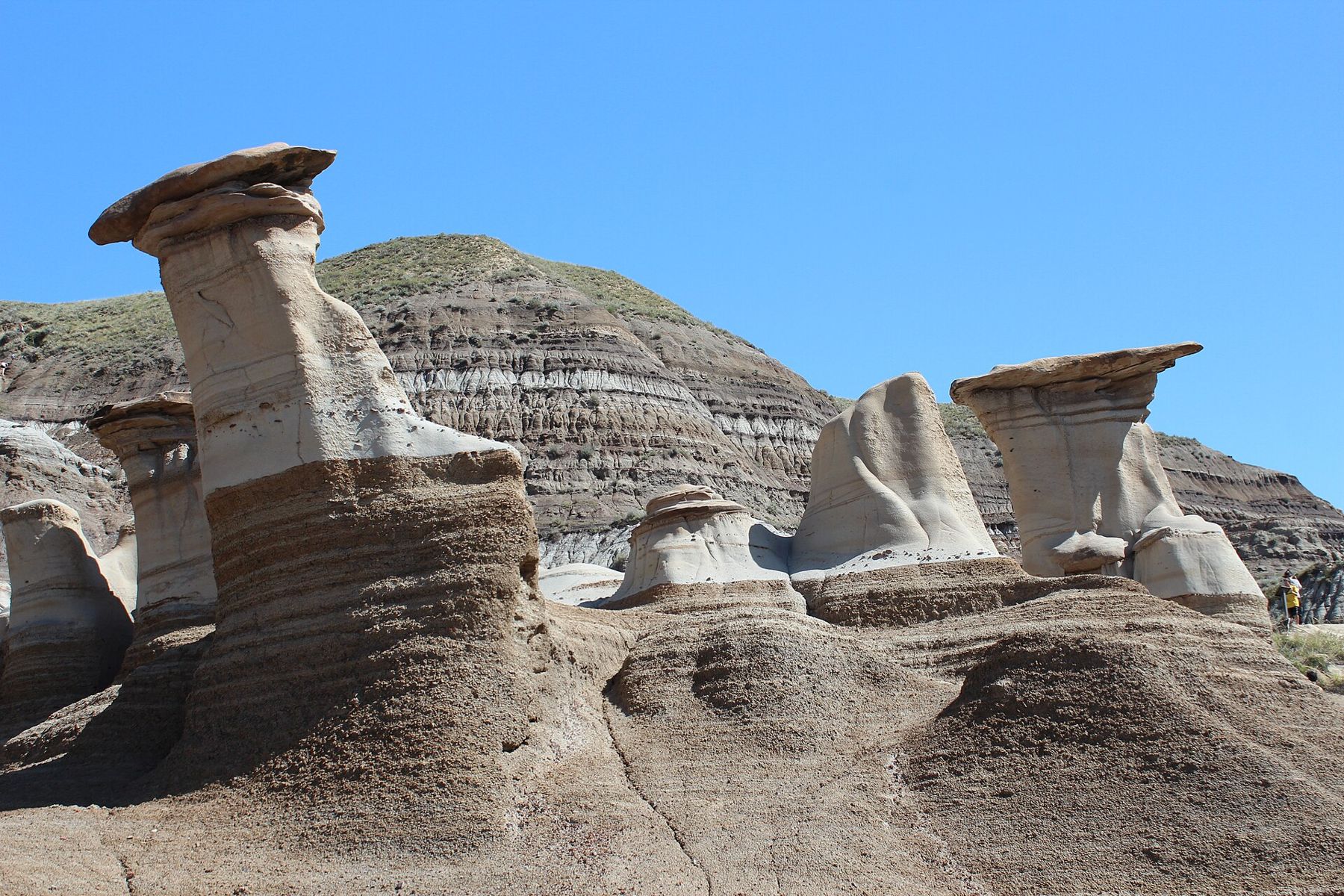
Eventually, every hoodoo loses its cap. When it does, the soft column below erodes quickly into a rounded mound and then disappears into the slope. Meanwhile, new hoodoos are slowly forming elsewhere on the hillside, wherever a hard layer lies over soft rock. What you see is one moment in a slow cycle.
Look closely at a single column and you can often see the layering continue through it: fine bands of slightly different colour and hardness, the same ones that run across the open slope behind. Where a softer band sits within the column, it may be pinched in like a waist. The base usually flares out into the hillside, buried in the debris that has washed down from above. Each hoodoo is not a separate object set on the slope, but a piece of the slope that has been left standing.
A hoodoo is a column of soft rock protected by a harder cap.
Why the pillars are fenced
The main group of hoodoos is fenced, and visitors are asked not to climb on them. The reason is simple: they are fragile. The columns are soft enough to scratch with a fingernail, and the caps sit loosely on top. Climbing, leaning or carving can break a cap or wear a column in minutes, undoing what took thousands of years.
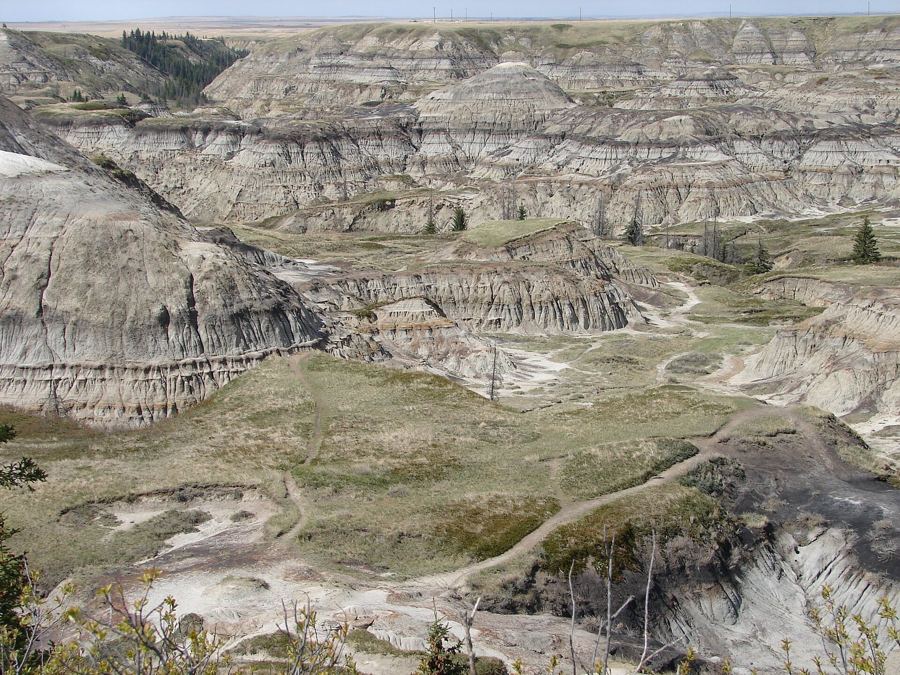 Further along the horizon · About 17 km south-westHorseshoe Canyon: the first look down
Treat them as you would a sculpture in a museum. Stay on the paths and boardwalks, keep children off the formations, and do not touch. The same applies to the slopes around them. Footprints in soft clay become channels for the next rain, and channels become gullies.
Walking the trail above the hoodoos
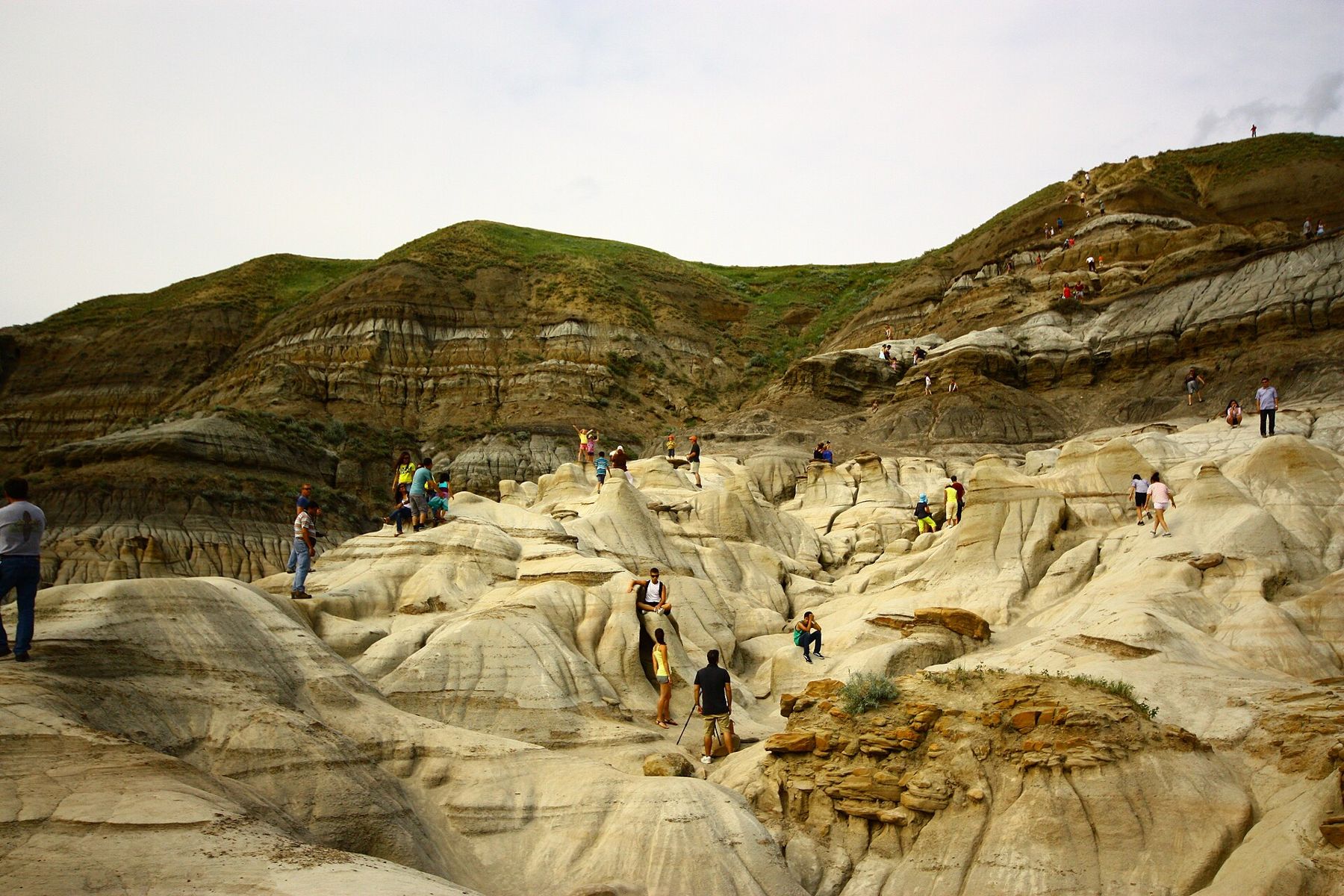
From the parking area, a short path with boardwalks and stairs leads up the slope beside the fenced hoodoos and onto the hillside above. The climb is modest, but the steps are steep in places and the ground is uneven. From the top you look down on the caps, across the road to the river and along the valley in both directions.
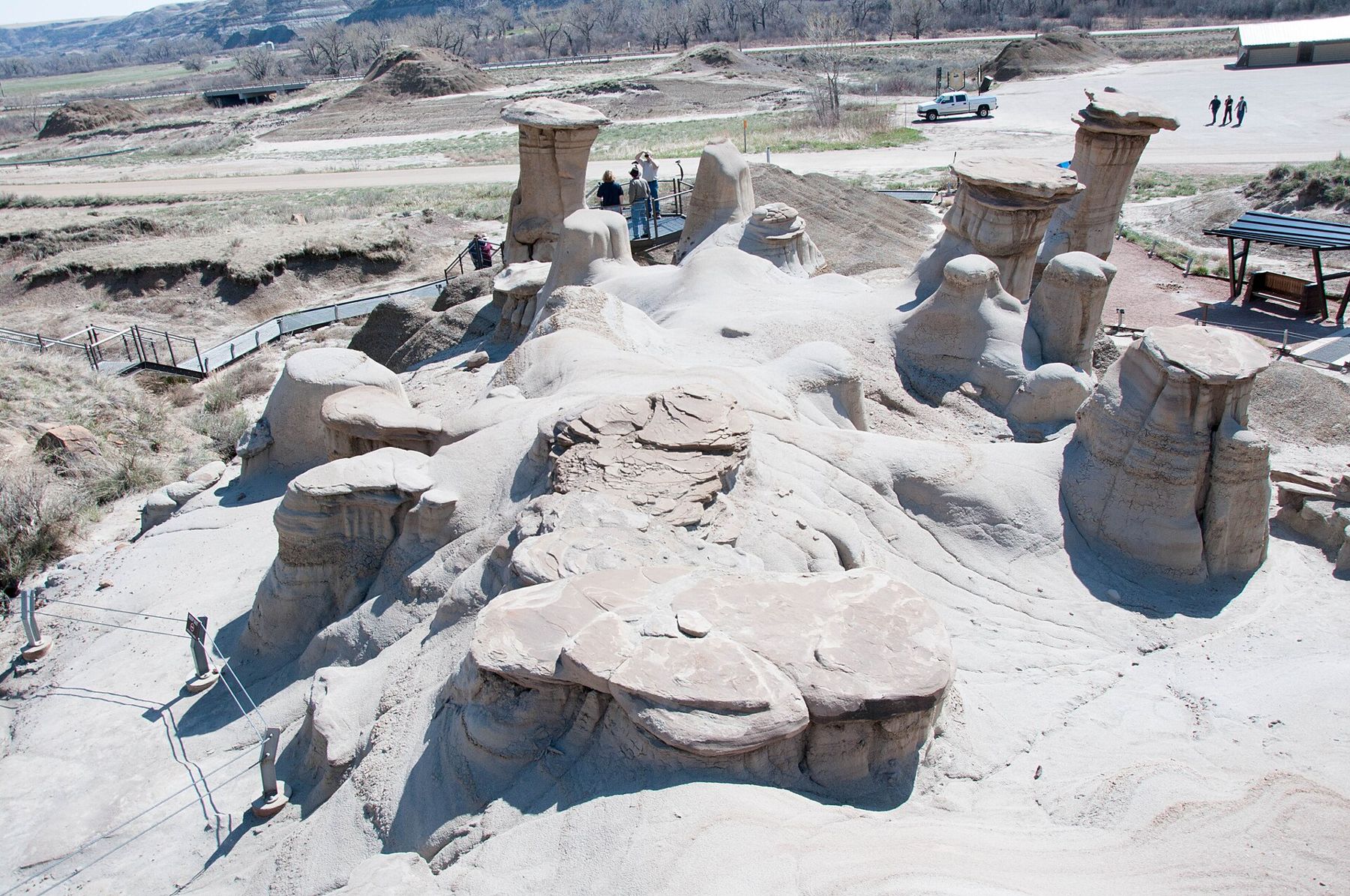
Informal paths lead further along the hillside, and many visitors wander among the bare slopes beyond the main group. Take care if you do. The ground is loose, the drops are real, and after rain the clay is slick enough to make even short slopes dangerous. Stay on the formed trail when in doubt.
The view from the upper slope is one of the best in this part of the valley. To one side, the river curves between cottonwood groves; to the other, bare hills fold into one another toward the rim of the plain. Early in the day, mist sometimes lies over the river while the hilltops are already in sun. If you have brought a camera, the upper slope looks down on the caps against the valley floor, a different picture from the usual one taken from the base.
- Arrive near sunrise for the softest light and the fewest people.
- Carry water; there is no shade on the slope.
- Wear shoes with grip, and wait for the clay to dry after rain.
- Watch for traffic when turning in and out of the parking area.
Erosion you can watch over the years
The hoodoos change faster than most landforms. Each spring, frost and meltwater loosen grains from the columns, and each summer thunderstorm washes more of the slope away. Over a few decades, visitors returning to the site notice differences: a cap that has slipped, a column that has thinned, a new pillar emerging on the slope above. Erosion here is a visible process, not an abstract one.
The same forces shaped the rest of the valley. At the end of the last ice age, floods of meltwater cut the Red Deer River valley deep into the plain, exposing the soft layers that rain and frost have been sculpting ever since. The hoodoos are a small, concentrated version of that story. For a larger one, stand on the rim at Horseshoe Canyon, or follow the road on to the Atlas Coal Mine at East Coulee, where the coal seams in the same rock were mined for decades.
Morning in the valley
The valley wakes slowly. On a clear summer morning, the first sun reaches the top of the slopes before it touches the river, and the hoodoos catch it while the road is still in shadow. Birds call from the cottonwoods along the river, and the air is cool enough for a jacket. The colours are at their richest: cream columns, brown caps, grey slopes and a deep blue sky.
Later in the day, the light flattens, and in July and August the heat on the slope can be intense. Evening is a second good time, as the sun drops behind the valley walls and the shadows lengthen. In winter, the hoodoos stand out sharply against snow, and the site is nearly empty. Whatever the season, give yourself time to stand still and look closely: the patterns in the columns, the cracks in the caps, and the slow work of water on stone.