DRUMHELLER · ABOUT 6 KM NORTH-WEST · DINOSAURS AND FOSSILS
A slow day at the Royal Tyrrell Museum
The museum sits low in a bowl of grey badlands just outside Drumheller. Give it a whole day, walk the coulee behind it, and let the crowds come and go around you.
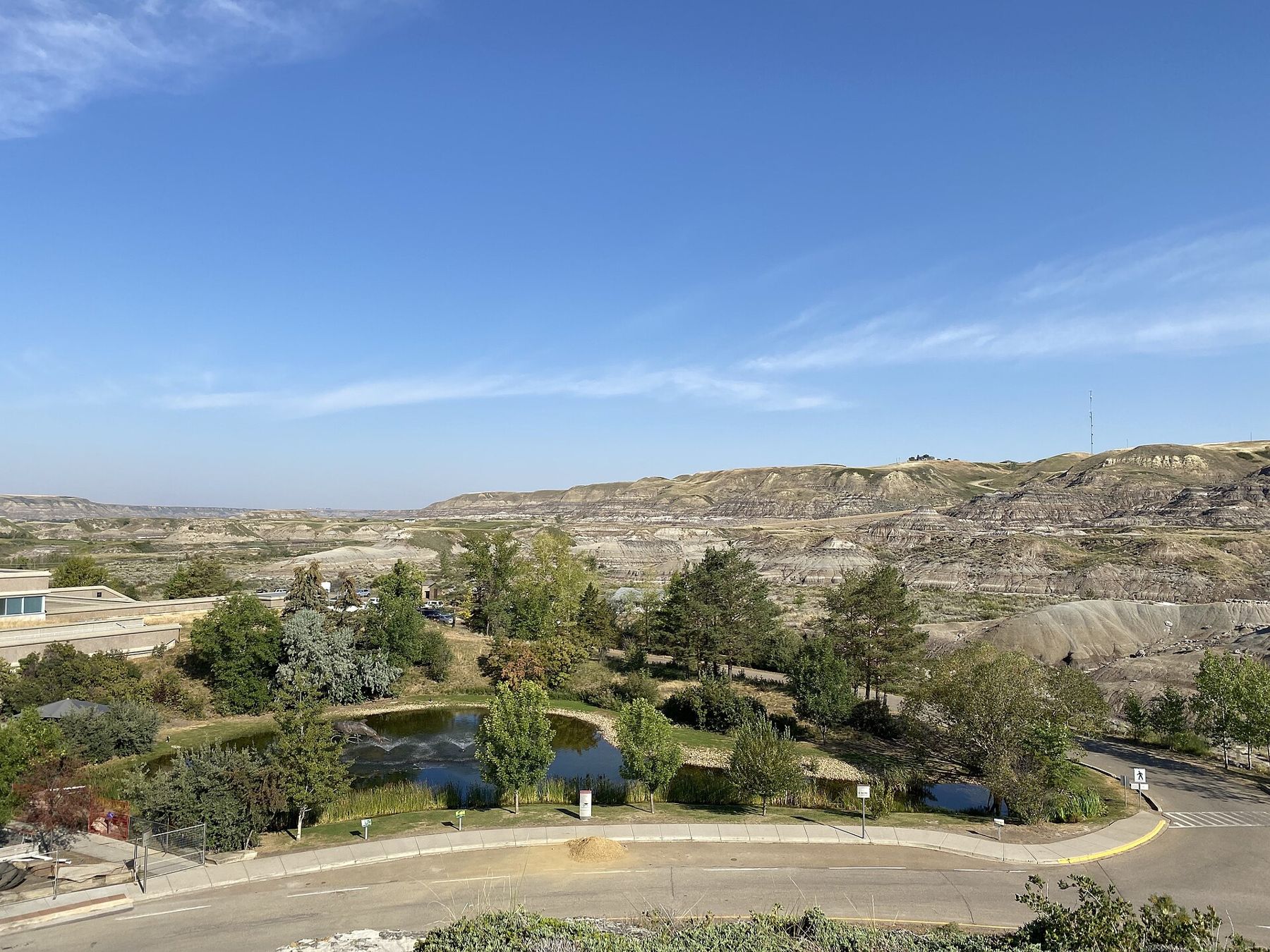
The road out of Drumheller climbs gently along the north side of the Red Deer River, and the museum appears almost without warning: a long, low building set into a fold of the badlands, its walls the same dusty colour as the hills. Behind it the slopes rise in grey, brown and rust bands. In front, a pond and a line of trees soften the approach. It is a large museum in a small valley, and the best way to see it is slowly.
The Royal Tyrrell Museum of Palaeontology opened in 1985. It takes its name from Joseph Burr Tyrrell, a geologist mapping coal in this valley in 1884, who came across the skull of a meat-eating dinosaur later named Albertosaurus. That find, and the coal he was looking for, set the pattern for the century that followed: miners and fossil hunters working the same layers of rock, often within sight of one another.
A museum set into Midland Provincial Park
The building stands inside Midland Provincial Park, a narrow strip of valley floor and coulee along Highway 838, the road locals call the North Dinosaur Trail. The park takes its name from a coal mine that once worked this stretch of the valley. Little of the mine remains to the eye, but the setting explains a great deal. The museum was built where the rock is: the same Horseshoe Canyon Formation that holds the bones inside is exposed in every slope around the car park.
That makes the museum unusual. In most cities, a natural history collection sits in a stone building far from where its specimens were found. Here you can walk out of a gallery, climb a short path and stand on sediment laid down by rivers and swamps at the end of the age of dinosaurs. The museum also works as a research centre, and staff head out into the badlands of the province each summer to collect.
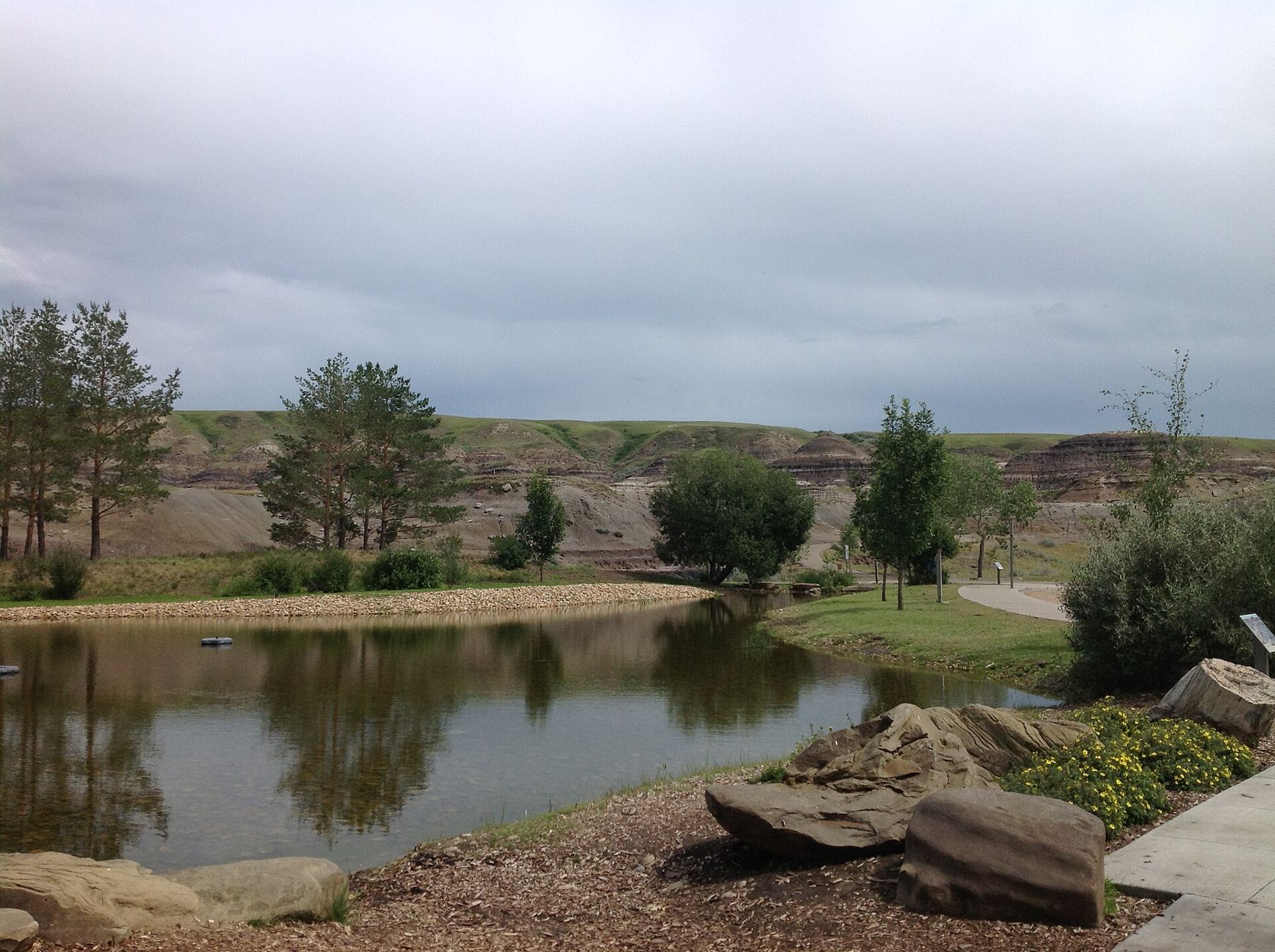
From the upper parking areas you look across the grounds toward the far side of the valley, where flat-topped hills mark the line of the old prairie surface. The North Dinosaur Trail carries on past the museum toward Horsethief Canyon and the river ferry, so the museum fits easily into a longer loop if you still have light at the end of the day.
Galleries that run through deep time
Inside, the galleries are laid out roughly in order of time, so a full circuit moves from the earliest traces of life through ancient seas and reefs, into the age of dinosaurs, and on toward the Ice Age. You do not need to follow it strictly, but walking it in order helps the scale of time make sense. The early halls are quieter and dimmer, with small fossils and models of strange sea creatures. Then the ceiling rises, and the skeletons begin.
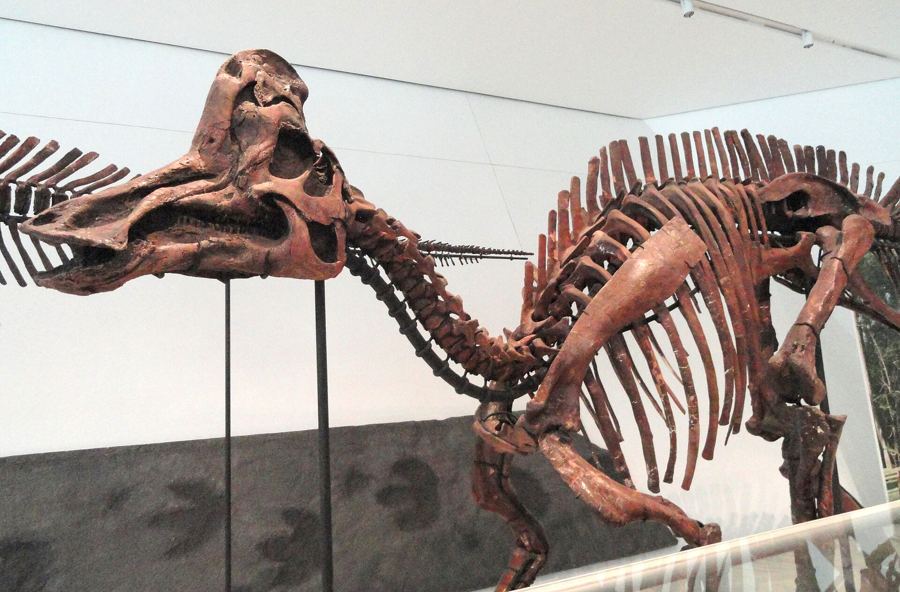
The large hall of dinosaurs is where most visitors stop and stay. Mounted skeletons stand at full height, some posed in mid-stride, and many of them were found in Alberta. Look for the fossils that were dug from rock within a short drive of the building; labels usually say where each one came from. One of the most striking pieces is an armoured dinosaur recovered from the oil sands of northern Alberta, preserved so completely that the shape of its body and its plates of armour survive in three dimensions. It looks less like a skeleton than a statue of the animal itself.
Further on, the galleries turn to the seas that once covered the plains and to the mammals that came after the dinosaurs. These rooms tend to be calmer in the middle of the day, when the dinosaur hall is at its busiest. Exhibits change over time, so treat any list you read elsewhere as a guide rather than a promise.
It is a large museum in a small valley, and the best way to see it is slowly.
The window into the preparation lab
Somewhere in the middle of the circuit, a long window looks into the preparation lab. This is where fossils that arrive from the field, still wrapped in plaster jackets and encased in rock, are slowly freed. Technicians work with fine tools, small air-powered chisels and brushes, often under magnifiers, and progress is measured in millimetres. On some days the benches are busy; on others there is little to see but covered specimens and tidy tools.
 Further along the horizon · Across the whole valleyFossils: look, photograph, leave them
It is worth stopping here for longer than seems necessary. The finished skeletons in the halls can look as if they came out of the ground whole. The lab shows the opposite: fragments, cracked bone, months or years of patient work, and decisions about what to keep and how to support it. It also explains why the province treats fossils as shared property. Every bone on display carries a record of exactly where it was found and in which layer, and that record is what makes it useful to science. A bone pulled out of a slope by a passer-by loses most of that value, which is why the rules on collecting are strict.
Out on the badlands trail
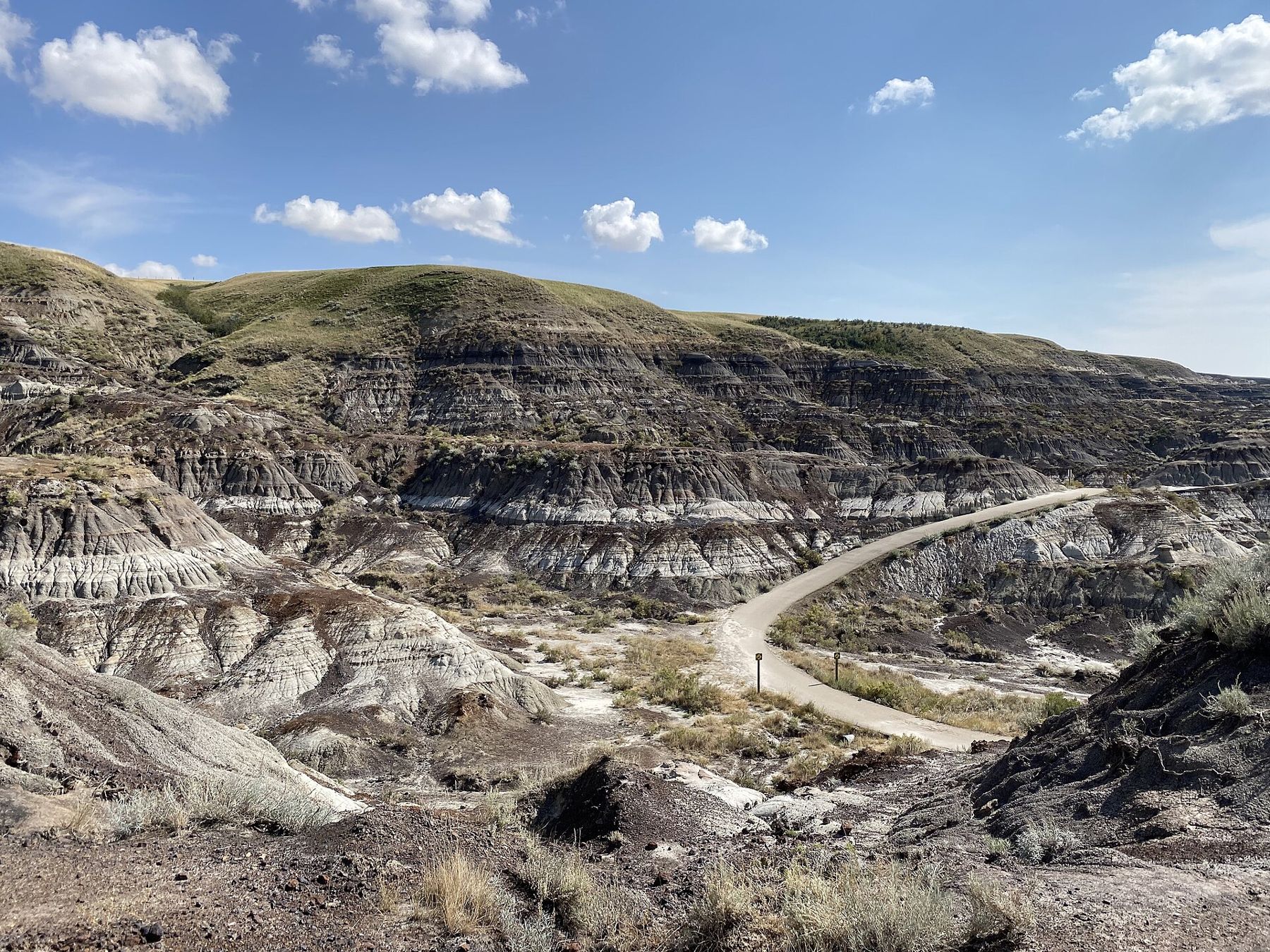
Behind the building, a short loop trail leads into the badlands. It is easy walking on a formed path, with interpretive signs along the way, and it takes you into a small world of rounded clay slopes, gullies and a few low hoodoos with flat sandstone caps.
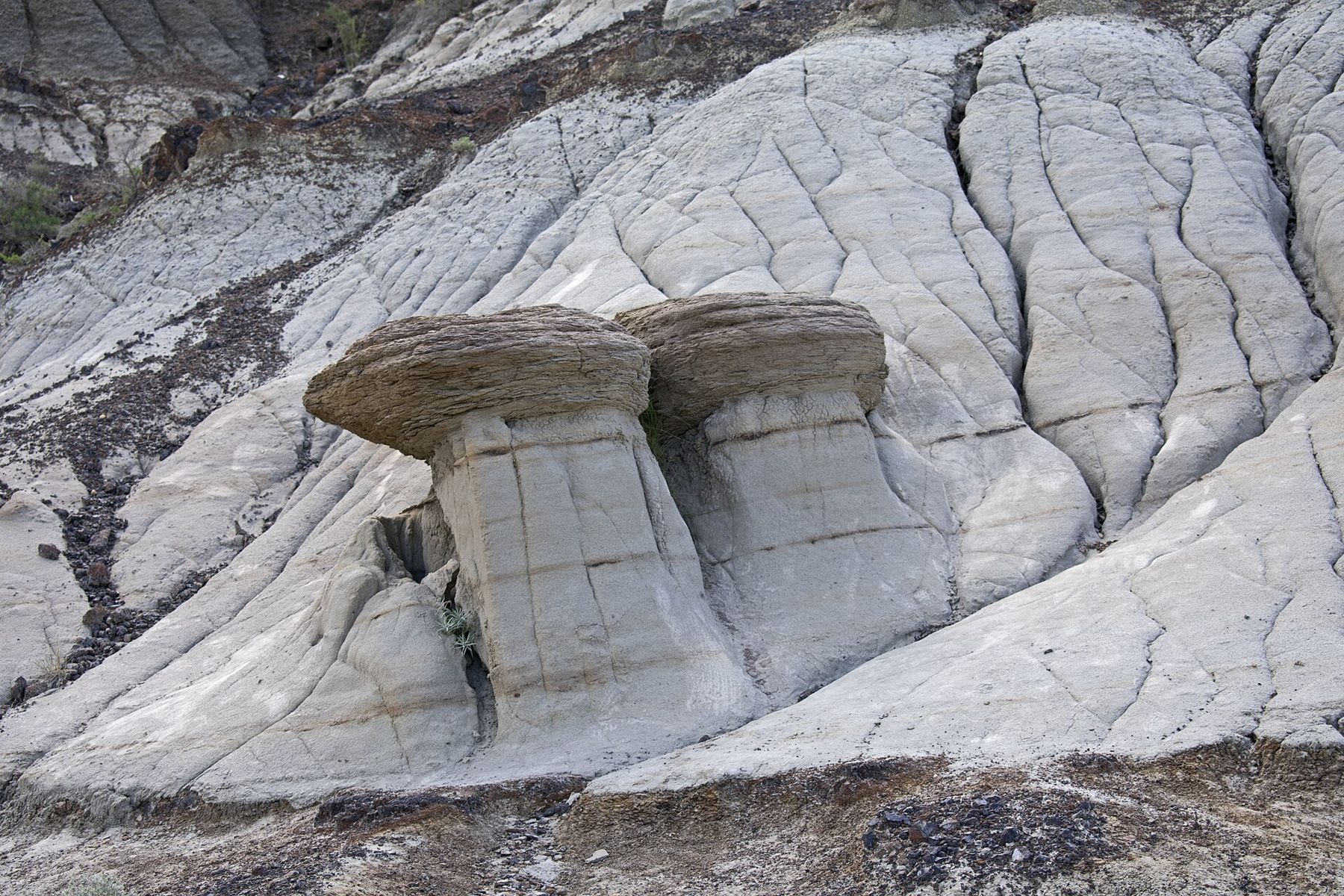
Up close, the slopes have the texture of dried skin. The grey and white clays swell when wet and crack as they dry, so the surface is always shifting and the plants that grow here are tough, low and grey-green: sage, small cactus and short grasses. In spring and early summer you may see wildflowers in the gullies. Stay on the path; the clay is easily damaged, and after rain it turns slick enough to make footing difficult even on gentle ground.
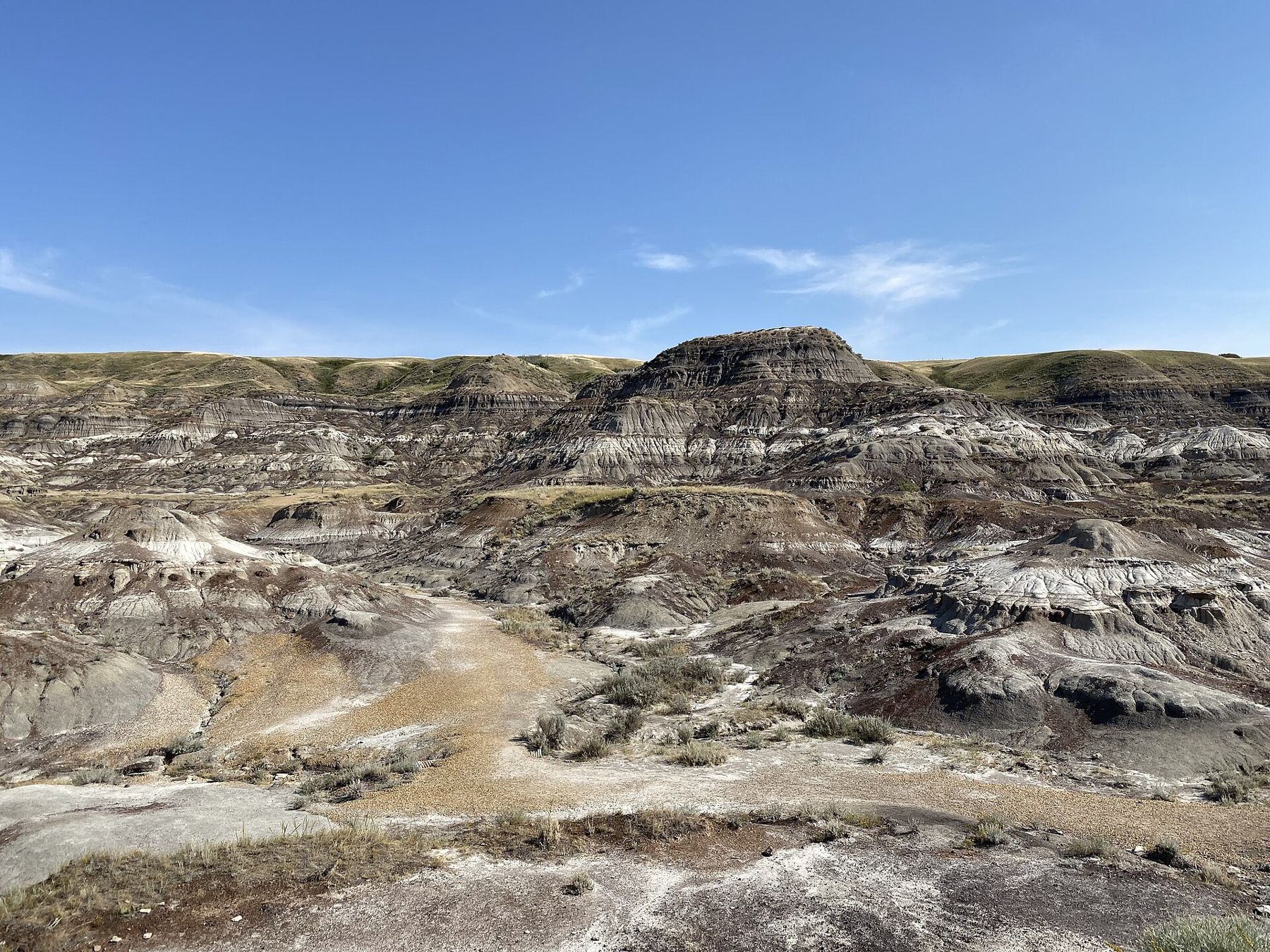
Look at the bands in the hillsides. Darker seams are coal and carbon-rich mud; pale layers are sandstone and ash-rich clay. Each band is a slice of time, laid down on river floodplains and in swamps near the edge of an inland sea. The walls of Horseshoe Canyon, a short drive to the south-west, show the same sequence on a grander scale.
How long, and when to arrive
A quick visit can be done in two or three hours, but it feels rushed. A slow day gives the galleries a full morning, a break outside, the trail in the afternoon, and a second look at the halls that caught your attention. Families with young children often find that half a day is enough before attention runs out; adults with an interest in geology can fill a whole day without trying.
Summer is the busy season. In July and August, and on long weekends, the car parks fill by late morning and the dinosaur hall becomes crowded. Arriving near opening time gives you an hour or so of quieter galleries. Late afternoon is also calmer, as day-trippers from Calgary start the drive home.
- Bring water for the trail; there is little shade outside.
- Wear shoes with grip if there has been rain.
- Plan for a hot afternoon in summer and a cold wind in the colder months.
- Allow time to sit; the views across the valley from the grounds are worth a pause.
Weather in the coulee
The valley is lower and more sheltered than the plain above, and in summer it heats quickly. By mid-afternoon the trail can feel much hotter than the town, with the pale clay throwing light and heat back up at you. Spring and autumn are gentler, with clear air and long shadows that bring out the banding in the hills. Thunderstorms build over the prairie on summer afternoons and can arrive fast; if you hear thunder, head back indoors. In winter the museum usually keeps shorter hours, and the badlands take on a dusting of snow that picks out every ridge.
When you leave, the road back to Drumheller runs along the valley with the town spread out on the flats ahead. If there is still light, the rim above the valley is worth the short climb by car, for the view of the coulees going blue in the evening.